
Evidence of the geological forces that have shaped Yellowstone are found in abundance in this district. The fascinating Old Faithful geology is closely tied to these features, as the hills surrounding Old Faithful and the Upper Geyser Basin are reminders of Quaternary rhyolitic lava flows. These flows, occurring long after the catastrophic eruption of 600,000 years ago, flowed across the landscape like stiff mounds of bread dough due to their high silica content.
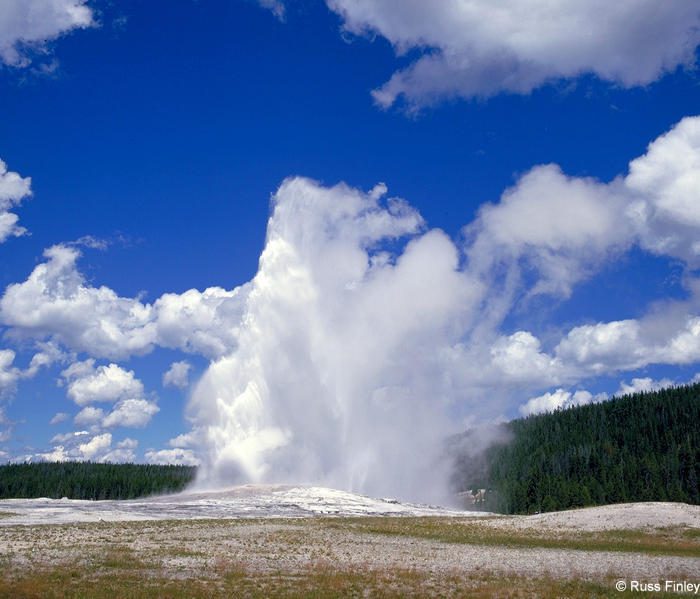
Evidence of glacial activity is common, and it is one of the keys that allows geysers to exist. Glacier till deposits underlie the geyser basins providing storage areas for the water used in eruptions. Many landforms, such as Porcupine Hills north of Fountain Flats, are comprised of glacial gravel and are reminders that as recently as 13,000 years ago, this area was buried under ice. Additionally, the Old Faithful geology is shaped by glacial processes, connecting past ice ages to the current landforms.
Signs of the forces of erosion can be seen everywhere, from runoff channels carved across the sinter in the geyser basins to the drainage created by the Firehole River, with the erosion revealing details about Old Faithful’s unique geology.
Mountain building is evident as you drive south of Old Faithful, toward Craig Pass. Here the Rocky Mountains reach a height of 8,262 feet, dividing the country into two distinct watersheds, and influencing the Old Faithful geology throughout the region.
Yellowstone is a vast land containing a landscape that is continually being shaped by geological forces, and Old Faithful’s geology is constantly changing as well.
The geology of the Old Faithful area, situated within the Upper Geyser Basin, is a masterpiece of plumbing and pressure. It is essentially a “hydrothermal engine” powered by the cooling magma of the Yellowstone supervolcano, which sits just 3 to 8 miles beneath your feet.
The Foundation: Rhyolite and Sinter
The ground you walk on in the Upper Geyser Basin is composed of rhyolitic lava flows, revealing fascinating details about Old Faithful geology.
- The Rock: Rhyolite is a volcanic rock extremely high in silica (SiO2), and central to understanding the geology of Old Faithful.
- The Sinter: As superheated water travels through this rhyolite, it dissolves the silica. When that water reaches the surface and cools, the silica precipitates out to form a hard, greyish-white crust called siliceous sinter (or geyserite), which plays a key role in Old Faithful geology.
- The Armor: This sinter isn’t just on the surface; it lines the geyser’s “pipes,” acting like a pressure-tight cement that allows the geyser to build up immense pressure without the walls of its plumbing collapsing—a critical aspect of Old Faithful geology.
Old Faithful’s “Heart”: The Plumbing System
Contrary to popular belief, Old Faithful does not look like a vertical straw underground. In 2017, a University of Utah study mapped its “heart” using small seismometers, helping scientists better understand Old Faithful’s geology.
- The Reservoir: Below the vent lies a massive, egg-shaped reservoir—a network of interconnected cracks and fractures rather than a single cavern. This reservoir is roughly 200 meters in diameter and can hold nearly 80 million gallons of water, revealing the complexity of Old Faithful geology.
- The Trap: The geyser has a specific “constriction” near the surface. This narrow point acts like a nozzle, trapping steam and building the pressure necessary for a vertical eruption, which is a crucial part of Old Faithful geology.
- Independent Plumbing: One reason Old Faithful is so “faithful” is that its plumbing is largely isolated. Many other geysers share water sources, making them erratic; Old Faithful has its own private “tank,” allowing it to recharge on a predictable schedule thanks to its distinct geology.
Why the Interval Changes
While it is called “Faithful,” the interval between eruptions has actually lengthened over the decades—from about 60 minutes in the 19th century to an average of 94 minutes today. Clearly, changes in Old Faithful geology contribute to these shifting eruption intervals.
- Earthquakes: Major seismic events (like the 1959 Hebgen Lake or 1983 Borah Peak quakes) physically shift the underground fractures, changing how fast the reservoir can refill, and this has a direct effect on Old Faithful geology.
- Water Supply: Drought years can slightly lengthen the interval as it takes longer for groundwater to replenish the system, further highlighting the impact of Old Faithful geology on eruption rhythm.
Fun Fact: During an eruption, Old Faithful expels between 3,700 and 8,400 gallons of water, yet this is only a tiny fraction (less than 0.01%) of the total water held in its underground reservoir.