Earthquake Information
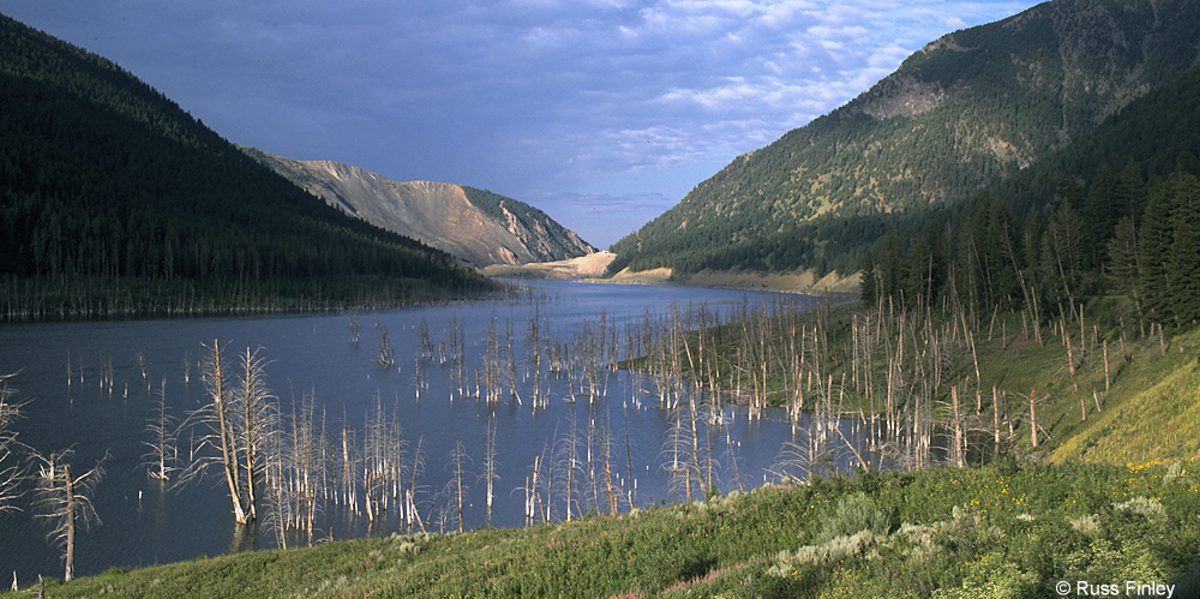
Although some quakes are caused by rising magma and hot-ground-water movement, many emanate from regional faults related to crustal stretching and mountain building. For example, major faults along the Teton, Madison, and Gallatin Ranges pass through the park and likely existed long before the beginning of volcanism there. Movements along many of these faults are capable of producing significant earthquakes. The most notable earthquake in Yellowstone’s recent history occurred in 1959. Centered near Hebgen Lake, just west of the park, it had a magnitude of 7.5. This quake caused $11 million in damage (equivalent to $110 million in 2022 dollars) and killed 28 people, most of them in a landslide that was triggered by the quake.
Geologists conclude that large earthquakes like the Hebgen Lake event are unlikely within the Yellowstone Caldera itself, because subsurface temperatures there are high, weakening the bedrock and making it less able to rupture. However, quakes within the caldera can be as large as magnitude 6.5. A quake of about this size that occurred in 1975 near Norris Geyser Basin was felt throughout the region.
Yellowstone is one of the most seismically active regions in the United States, experiencing between 1,500 and 2,500 earthquakes every year. While the idea of thousands of quakes sounds alarming, the vast majority are “micro-earthquakes” (magnitude 2.0 or lower) that cannot be felt by humans.
As of February 2026, the park is currently at normal “background” levels of activity, following a slightly quieter-than-average 2025.
Why So Many Quakes?
Almost all earthquakes in Yellowstone are brittle-failure events, which occur when rocks break due to intense crustal stress. These stresses are caused by three main factors:
- Tectonic Stretching: The Earth’s crust in this region is being pulled apart (extension).
- Hydrothermal Fluids: Superheated water and gases moving through underground cracks can “lubricate” faults, causing them to slip.
- Magmatic Movement: Though less common, the shifting of magma deep underground can also create seismic pressure.
The “Yellowstone Swarms”
About 50% of Yellowstone’s earthquakes occur in swarms—clusters of quakes that happen in the same area over a short period with no single “mainshock.”
- The 1985 Swarm: The largest recorded swarm in park history, with over 3,000 events over three months.
- The 2017 Maple Creek Swarm: One of the longest in recent memory, lasting several months with over 2,400 located quakes.
- Current 2025-2026 Activity: In late 2025, a new swarm occurred south of Norris Geyser Basin, coinciding with a subtle ground uplift. Scientists are currently monitoring this to see if it follows the “breathing” pattern of the caldera.
Earthquakes vs. Geysers
Earthquakes are actually essential to the survival of Yellowstone’s famous geysers.
- Keeping the Pipes Open: Silica minerals in the water constantly build up, threatening to clog geyser conduits. Small quakes act as a “plumbing service,” shaking the ground enough to crack those mineral deposits and keep the water flowing.
- Changing the Show: Large quakes can instantly alter geyser behavior. After the 1959 Hebgen Lake quake (magnitude 7.3), at least 289 springs erupted as geysers for the first time, while others went dormant.
2026 Status Update
| Metric | 2025 Total | January 2026 |
| Total Earthquakes | 1,119 (Below average) | 100 |
| Largest Event | M 3.7 (Northwest Park) | M 2.6 (West Yellowstone) |
| Volcanic Alert Level | Normal | Normal |
Note on Safety: While a “supereruption” is the stuff of movies, the real geological hazard in Yellowstone is a large tectonic earthquake (like 1959) or a hydrothermal explosion, both of which are much more likely than a volcanic eruption.