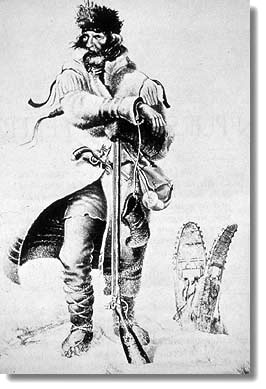
John Colter: The Man Who Found “Hell” in Yellowstone
Before it was a world-renowned sanctuary of geothermal wonders and the crown jewel of the American National Park system, Yellowstone was a place of myth. To the skeptics of the early 19th century, it was known as “Colter’s Hell”—a name born from the reports of John Colter, the explorer who saw the impossible and lived to tell of it.
From the Corps of Discovery to the Great Unknown
John Colter’s journey into history began as a member of the Lewis and Clark Expedition (1804–1806). A skilled hunter and scout, Colter was so enamored with the wilderness that as the expedition was returning to St. Louis in 1806, he requested an honorable discharge to remain in the mountains.
In the winter of 1807–1808, acting as a messenger for fur trader Manuel Lisa, Colter embarked on a solo 500-mile trek through what is now northwest Wyoming. Carrying only a thirty-pound pack and his rifle, he became the first person of European descent to witness the Teton Mountain Range and the geothermal basins of Yellowstone, a feat that genuinely speaks to John Colter’s pioneering spirit.
The Landscape of “Colter’s Hell”
When Colter returned to civilization, his descriptions of the region were met with ridicule. He spoke of:
- Boiling mud pots that hissed and bubbled.
- Geysers that launched scalding water hundreds of feet into the air.
- Hidden fires and the “all-pervading smell of brimstone” (sulfur).
The public, believing Colter had finally succumbed to the “mountain madness,” mockingly dubbed his discovery Colter’s Hell. Interestingly, modern historians suggest the specific “Hell” he described might have been a thermal area near present-day Cody, Wyoming, but the name eventually became synonymous with the entire mysterious Yellowstone plateau, all due to John Colter’s legendary accounts.
The Legend of “Colter’s Run”
While his discovery of Yellowstone was historic, Colter’s most famous exploit occurred in 1809 near the Three Forks of the Missouri. Captured by a large party of Blackfeet Indians, Colter’s companion, John Potts, was killed. Colter, however, was stripped naked and given a 300-yard head start to run for his life. According to the legend, John Colter survived the ordeal against all odds.
“He ran with a speed that surprised even himself… the soles of his feet were filled with the thorns of the prickly pear.”
Against all odds, Colter outran the hunting party for five miles, killed a single pursuer who had caught up to him, and hid in a beaver lodge until nightfall. He then walked 300 miles back to Manuel’s Fort, naked and starving, arriving eleven days later. For anyone interested in heroic wilderness adventures, the saga of John Colter stands unmatched.
A Legacy Written in Steam and Stone
John Colter died in 1813, decades before the world would officially acknowledge that his “tall tales” were absolute truth. It wasn’t until the 1871 Hayden Expedition provided photographic proof that the American public realized the “Hell” Colter described was actually a paradise of natural wonders. Today, the name John Colter is synonymous with adventure and trailblazing discovery in the American West.
Today, Colter is remembered as the “First Mountain Man.” His name is immortalized in Colter Bay in Grand Teton National Park, serving as a permanent tribute to the scout who walked alone into the heart of the American West, following in the footsteps of legendary John Colter.