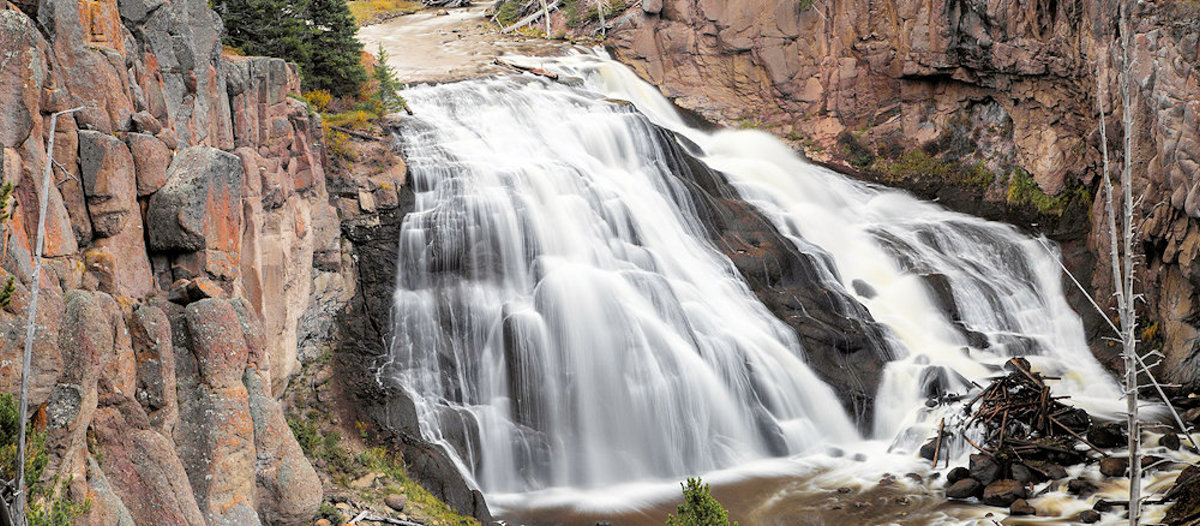
Gibbon Falls is one of the most accessible and picturesque waterfalls in Yellowstone National Park. Dropping approximately 84 feet (26 m), it cascades in a fan-like shape over the edge of the Yellowstone Caldera, the remnant of a massive volcanic eruption that occurred about 631,000 years ago.
Location and Accessibility
The falls are located in the western part of the park on the Grand Loop Road, roughly halfway between Madison Junction and Norris Geyser Basin.
- Parking: There is a large, designated pull-off with a parking lot. It can get crowded during midday, so early morning or late afternoon visits are recommended.
- Accessibility: The viewing area features a paved, wheelchair-accessible path that stretches about 0.5 miles round-trip.
- Ease of View: Unlike many other falls in the park, Gibbon Falls requires no strenuous hiking. You can see the falls almost immediately after stepping out of your car.
Geological and Natural Significance
- The Caldera Rim: The falls mark the spot where the Gibbon River drops off the northern escarpment of the caldera into the lower basin.
- Fishery Barrier: Historically, the falls served as a natural barrier to fish migration. Before the 1890s, the river above the falls was completely fishless because species like the Arctic Grayling could not leap over the 84-foot drop.
- Nearby Features: Just south of the falls is Tuff Cliff, a wall of volcanic ash that was compressed into hard rock thousands of years ago.
History
The falls were officially described in 1872 during the Hayden Geological Survey by photographer William Henry Jackson. The river and falls are named after Colonel John Gibbon, a Civil War general and explorer who led an expedition through the area in the 1870s.