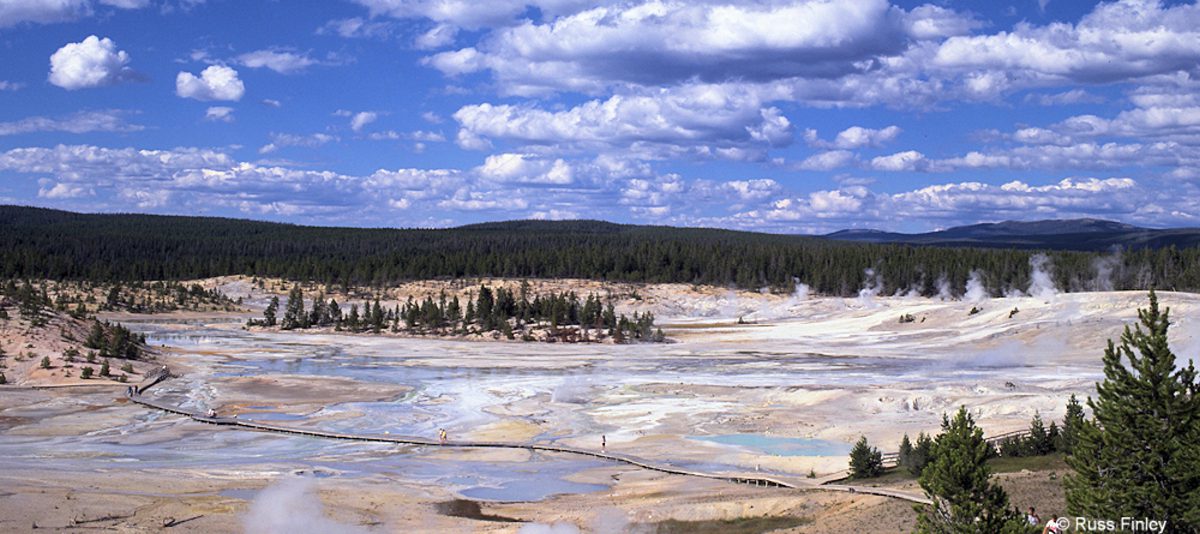
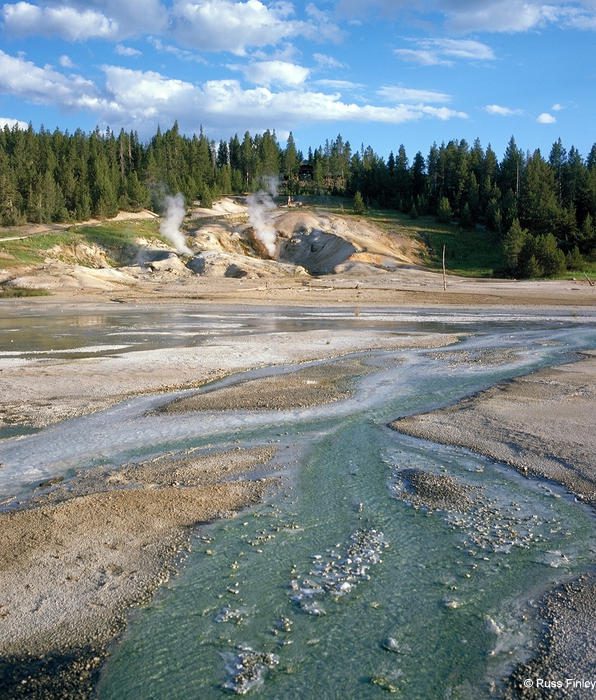
Norris sits at the intersection of three major tectonic features, which explains its extreme intensity: Yellowstone Norris geology is truly fascinating due to these powerful forces at work.
The Hebgen Lake Fault System: An east-west fault zone that extends from Montana into the park.
The Yellowstone Caldera Rim: It sits just outside the north rim of the 631,000-year-old caldera.
The Norris-Mammoth Corridor: A north-south fault zone that funnels heat from the caldera toward Mammoth Hot Springs.
The Hebgen Lake fault experienced an earthquake in 1959 that measured 7.4 on the Richter scale (sources vary on exact magnitude between 7.1 and 7.8). These two faults intersect with a ring fracture that resulted from the Yellowstone Caldera of 600,000 years ago. These faults are the primary reason that Norris Geyser Basin is so hot and dynamic. The Ragged Hills that lie between Back Basin and One Hundred Springs Plain are thermally altered glacial moraines. As glaciers receded, the underlying thermal features began to express themselves once again, melting remnants of the ice and causing masses of debris to be dumped. These debris piles were then altered by steam and hot water flowing through them.
Madison lies within the eroded stream channels cut through lava flows formed after the caldera eruption. The Gibbon Falls lies on the caldera boundary as does Virginia Cascades.
Because of these intersecting cracks in the Earth’s crust, heat from the underlying magma can rise much more easily here than elsewhere. A research well drilled at Norris once recorded a temperature of 459°F (237°C) just 1,087 feet below the surface.
Acid vs. Alkaline: The Chemistry of Norris
Norris is unique because it contains two very different types of thermal water in close proximity:
- Neutral-Chloride Water: This is the “standard” geyser water found in the Upper Geyser Basin. It is rich in silica and creates the white siliceous sinter (geyserite) that forms geyser cones.
- Acid-Sulfate Water: This is where Norris gets its “alien” reputation. Steam containing hydrogen sulfide gas rises and reacts with oxygen and bacteria to create sulfuric acid. This acid eats away at the rock, turning it into clay and creating colorful, boiling pools with a pH similar to battery acid or vinegar.
The Hybrid: Norris is one of the few places on Earth where you can find acidic geysers, such as Echinus Geyser, which has a pH of roughly 3.5.
Steamboat Geyser: The World’s Tallest
The crown jewel of the Norris Back Basin is Steamboat Geyser. Unlike Old Faithful, which has a shallow “bubble trap,” Steamboat is believed to have a very deep reservoir.
- The Power: When it erupts, the deep water is under immense pressure. As it flashes to steam, it has more energy than any other geyser, blasting water over 300–400 feet into the air.
- Current Phase: Steamboat is notoriously erratic. After decades of relative silence, it entered a major active phase in 2018 that has continued into the 2020s. In some years, it has erupted nearly 50 times.
The “Annual Thermal Disturbance”
Every year, usually in late summer, Norris undergoes a “thermal disturbance.”
- What happens: For reasons scientists still don’t fully understand, the entire basin’s plumbing seems to shift at once. Clear pools become muddy and boil violently, new steam vents (fumaroles) break through the boardwalks, and dormant geysers suddenly spring to life.
- The Cause: It is likely tied to changes in the water table and underground pressure as the spring snowmelt dries up, allowing steam to dominate the plumbing system.
2026 Geologic Update
As of February 2026, scientists are closely monitoring a subtle ground uplift just south of Norris. InSAR satellite data from late 2025 showed the ground rising at a rate of about 2–3 cm per year. While this is a normal part of the “breathing” of the Yellowstone volcano, it often precedes shifts in geyser activity or increased frequency in Steamboat’s eruptions.