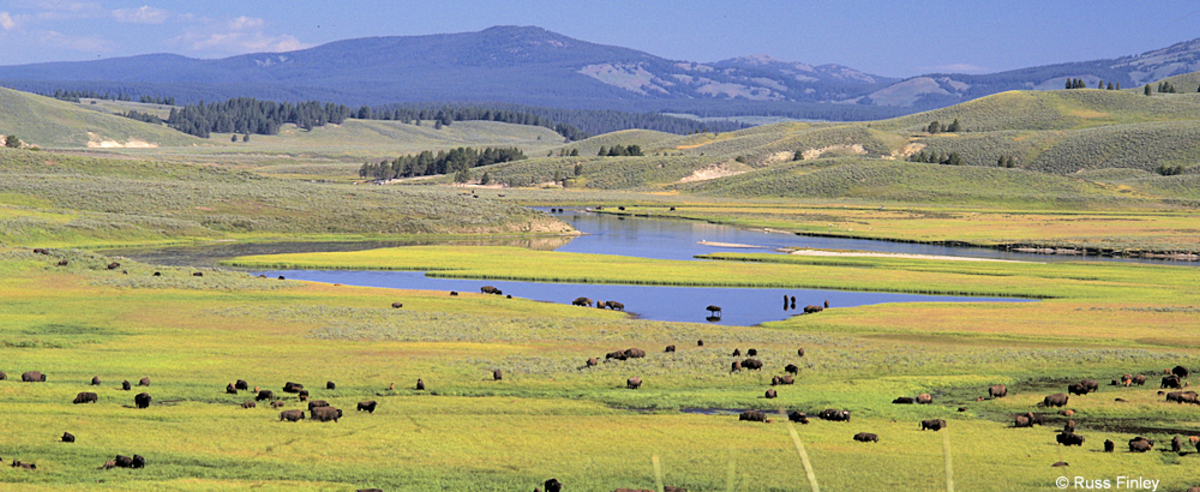
3) Hayden Valley – This valley, centrally located in Yellowstone National Park, is the first place to go to see wildlife in Yellowstone. As you drive along this beautiful, broad valley you are likely to see herds of bison, scattered elk (and the occasional herd), and the occasional grizzly bear. You are also likely to see waterfowl, including ducks, Canada geese and pelicans, swimming in or lounging near the Yellowstone River.

There are a number or roadside turnouts along the Hayden Valley, offering views on both sides of the road. The Yellowstone river is positioned on the east side of the roadway. Several turnouts are scenic overlooks that allow panoramic views of the Valley floor below.
The Hayden Valley was once filled by an arm of Yellowstone Lake. Therefore, it contains fine-grained lake sediments that are now covered with glacial till left from the most recent glacial retreat 13,000 years ago. Because the glacial till contains many different grain sizes, including clay and a thin layer of lake sediments, water cannot percolate readily into the ground. This is why the Hayden Valley is marshy and has little encroachment of trees.
While the erupting geysers of Old Faithful and the vibrant colors of Grand Prismatic Spring often steal the spotlight, Hayden Valley remains the true “wild heart” of Yellowstone National Park. This vast, rolling landscape of sub-alpine meadows and winding riverbanks serves as the park’s premier stage for wildlife viewing and a window into its ancient geological past.
A Glacial Legacy: Why No Trees?
At nearly 8,000 feet in elevation, Hayden Valley is a striking exception to the dense lodgepole pine forests that cover much of Yellowstone. 1 Its open, grassy character is a direct result of its geological history.
During the last ice ages, the valley was the floor of an ancestral Yellowstone Lake, which was much larger than the lake we see today. As the glaciers receded, they left behind thick layers of fine-grained glacial and lake sediments, primarily clay. These compact soils are so dense and poorly drained that they prevent tree roots from taking hold, creating the perfect environment for the sprawling meadows and wetlands that sustain the park’s largest herds.
The Serengeti of North America
Hayden Valley is globally renowned for its high concentration of large mammals. It is one of the few places on Earth where you can easily watch wolves, grizzly bears, and bison interact from the safety of a roadside pullout.
- The Bison Rut: The valley is home to the central bison herd. During the late summer (July and August), the “rut” or mating season begins. Thousands of bison congregate here, and the valley echoes with the deep, guttural bellows of competing bulls—a spectacle often compared to the Great Migration in Africa.
- Apex Predators: Because of the high density of prey, grizzly bears and wolves are frequent visitors. Grizzlies are often seen foraging for roots or scavenging carcasses, while the Wapiti Lake wolf pack is known to frequent the valley’s northern reaches.
- Birding Paradise: The Yellowstone River meanders slowly through the valley, creating marshes that attract Trumpeter Swans, American White Pelicans, and Sandhill Cranes. Look toward the tree-lined ridges to spot Bald Eagles and Osprey hunting for trout.
Exploring the Valley
Most visitors experience the valley via the Grand Loop Road, which runs directly through the center of the meadows. However, for those looking to immerse themselves further, several key spots offer unique perspectives:
| Feature | Description |
| Grizzly Overlook | Located at the north end, this elevated pullout provides a panoramic view of the valley floor, perfect for spotting movement in the distance. |
| Mud Volcano | On the southern edge, this thermal area features “Dragon’s Mouth Spring” and “Sulphur Caldron,” where the park’s volcanic heat meets the valley’s edge. |
| Mary Mountain Trail | A challenging 20-mile hike that crosses the valley. Note: This is prime grizzly territory; hiking in groups of four or more and carrying bear spray is essential. |
| LeHardy’s Rapids | A short walk to the river where you can watch Cutthroat Trout jumping upstream during their spring spawning run. |
Tips for a Successful Visit
- The “Golden Hours”: Wildlife is most active at dawn and dusk. Aim to be in the valley by sunrise to catch wolves and bears before the midday heat drives them into the shade.
- Bring Optics: While bison are often right next to the road, predators are usually far in the distance. High-quality binoculars or a spotting scope are essential for a good experience.
- Respect the Distance: Park regulations require staying at least 100 yards from bears and wolves and 25 yards from all other wildlife, including bison.
- Check the Carcass Report: If you see a large group of people with scopes parked at a pullout, they are likely watching a “carcass.” These are major magnets for activity and offer the best chance to see multiple predators in one spot.
2 thoughts on “Hayden Valley”
Comments are closed.