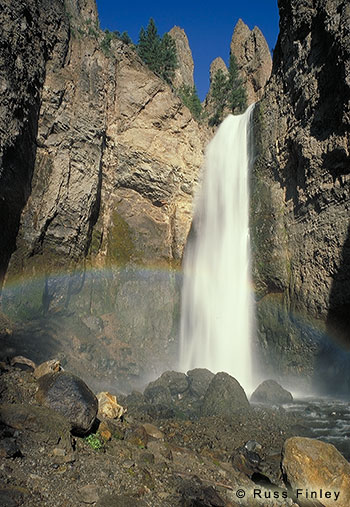
8 ) Tower Fall – This is the most popular waterfall in Yellowstone other than the Lower Falls of the Grand Canyon. The waterfall is located behind the General Store. A short walk will take you to an overlook, but we also recommend you take the short-but-steep hike down to the base of the waterfall.
Tower Fall is also a popular winter destination. It is accessible via cross-country skies or snowshoes by following the Roosevelt Junction to Tower Fall road.
Tower Fall is 17 miles north of Canyon or two miles south of Roosevelt. During the winter months, the frozen falls are accessible via cross country skies.
Brief Description and History
A half-mile steep, switchback hike downward takes you to the bottom of the waterfall. Take the same trail back up. The trail is also accessible during the winter months, but skiers should pack in shoes appropriate for descending the very icy trail. During the winter months, the entire waterfall is encased in an ice dome. The name “Tower” is derived from the towering volcanic formations surrounding the top of the falls.
While Yellowstone is home to hundreds of waterfalls, Tower Fall holds a special place in the park’s history. Located in the northeastern Tower-Roosevelt region, this 132-foot plunge of Tower Creek is famous for the dramatic volcanic pinnacles that frame its brink—a sight so moving it helped convince Congress to establish Yellowstone as the world’s first national park.
A Masterpiece of Geology and Art
The name “Tower Fall” (singularized by the U.S. Geological Survey in 1928) comes from the tower-like rock formations created by ancient volcanic activity. These spires are composed of volcanic breccia—a mix of rock fragments and ash—that proved more resistant to erosion than the surrounding soil.
- Thomas Moran’s Influence: In 1871, artist Thomas Moran and photographer William Henry Jackson documented the falls. Moran’s vivid painting of Tower Fall was instrumental in showcasing the beauty of the West to lawmakers in Washington D.C., leading to the park’s creation in 1872.
- The “Vanishing” Boulder: For over a century, a large boulder sat precariously at the very lip of the falls. In June 1986, gravity finally won, and the boulder tumbled into the pool below, permanently altering the waterfall’s silhouette.
Visiting the Falls
Tower Fall is one of the most accessible major features in the park, though some of its historic views have changed over time.
| Feature | Details |
| The Overlook | An easy, 150-yard paved walk from the parking lot leads to a head-on view of the falls. This path is ADA-accessible with a gentle 2-4% grade. |
| Yellowstone River Trail | For those seeking a workout, a steep dirt trail descends roughly 300 feet over 0.5 miles to the banks of the Yellowstone River. |
| Important Note | The trail to the base of the waterfall was permanently closed in 2004 due to severe landslips. There is currently no safe or legal way to reach the bottom of the falls. |
Wildlife and Nearby Attractions
The Tower-Roosevelt area is “bear country,” and Tower Fall is no exception. It is common to see black bears foraging on the hillsides surrounding the falls, especially in the spring and early summer.
- Calcite Springs: Just north of the falls, an overlook provides a view of hydrothermal oil seeps and spectacular basalt columns that resemble a “palisade” along the canyon wall.
- Roosevelt Lodge: Located two miles away, this historic lodge offers a glimpse into the “Old West” with stagecoach rides and a popular western cookout.
- Mount Washburn: The road south from Tower Fall climbs toward Dunraven Pass, the gateway to one of the park’s most popular peak hikes.
Pro-Tips for Your Visit
- Stop for Soft Serve: The Tower Fall General Store is famous among park regulars for its ice cream—a perfect reward after the steep hike back up from the river.
- Go Early or Late: The parking lot is relatively small and fills up quickly during the summer months. Arriving before 9:00 AM or after 5:00 PM will help you avoid the crowds.
- Spring Spectacle: To see the falls at their most thunderous, visit in late May or June during the peak of the spring snowmelt.