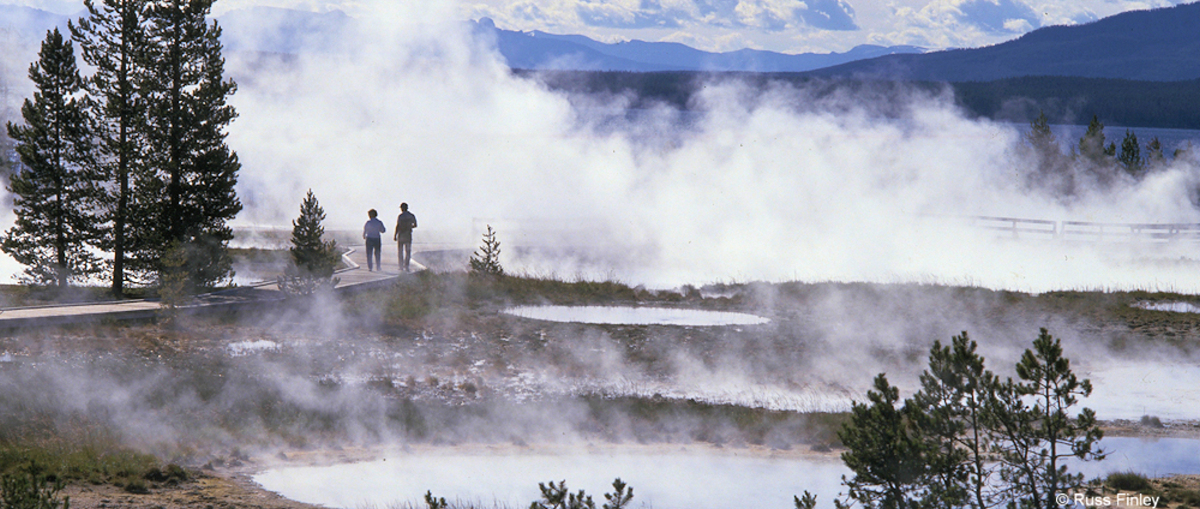
10) West Thumb Geyser Basin — This geyser basin features some interesting thermal features, including several which are in Yellowstone Lake itself. It also offers a good view of the Lake.
Several hiking trails begin at the basin, and bison, elk and bears frequent the area. The basin is a favorite stopping point for snowmobilers and snowcoaches in the winter months.
Perched on the edge of the deepest lake in North America above 7,000 feet, West Thumb Geyser Basin is one of Yellowstone’s most scenic thermal areas. While smaller than the sprawling basins near Old Faithful, West Thumb offers a unique “fire and ice” experience, where boiling hydrothermal vents sit directly adjacent to—and sometimes inside—the frigid waters of Yellowstone Lake.
A Caldera Within a Caldera
West Thumb is not just a bay; it is a volcanic crater. Approximately 150,000 to 180,000 years ago, a massive volcanic eruption caused the ground to collapse, creating the West Thumb Caldera.
This smaller caldera eventually filled with water, becoming a “thumb-like” projection of the much larger Yellowstone Lake. Today, the heat from the underlying magma chamber still powers a dense concentration of hot springs, mud pots, and geysers along this ancient shoreline.
Iconic Features of West Thumb
The basin is famous for its diverse range of hydrothermal features, all accessible via a 0.6-mile boardwalk loop.
- Fishing Cone: Perhaps the most legendary feature in the park, this geyser cone sits right on the lake’s edge. Early explorers used to catch cutthroat trout in the cold lake and, without removing them from the hook, swing them into the boiling water of the cone to cook them instantly. (Note: This “boiled trout” practice is now strictly illegal).
- Abyss Pool: Reaching a depth of 53 feet, this is one of the deepest hot springs in the park. Its deep green and turquoise hues create a stunning, “bottomless” illusion.
- Black Pool: Despite its name, Black Pool is now a brilliant blue. In the past, lower temperatures allowed dark-colored thermophiles (heat-loving bacteria) to thrive, giving it a black appearance. After a shift in thermal activity in 1991, the pool heated up, killing the dark bacteria and revealing the clear blue water.
- Thumb Paint Pots: These are “acid-sulfate” features where sulfuric acid breaks down rock into gray and pastel-colored clay. They are often frothy and bubbling, looking like a simmering vat of paint.
Underwater Mysteries
One of the most fascinating aspects of West Thumb is what lies beneath the surface of the lake. Scientists have mapped over 150 hydrothermal vents and several large explosion craters on the lake floor.
During the early summer, when lake levels are high, shoreline features like Lakeshore Geyser and Fishing Cone are often partially or completely submerged, visible only as mysterious, bubbling circles in the cold lake water.
Visiting Tips
| Recommendation | Details |
| Best Time | Dawn or dusk. The steam rising from the pools against the rising or setting sun provides incredible photography opportunities. |
| Wildlife | Keep an eye out for elk and moose, which are frequently seen near the Grant Village area and along the shoreline. |
| Accessibility | The boardwalk is wheelchair and stroller friendly, making it a great stop for families. |
| Nearby Stop | The West Thumb Information Station, a historic log building from 1925, offers exhibits and a bookstore. |