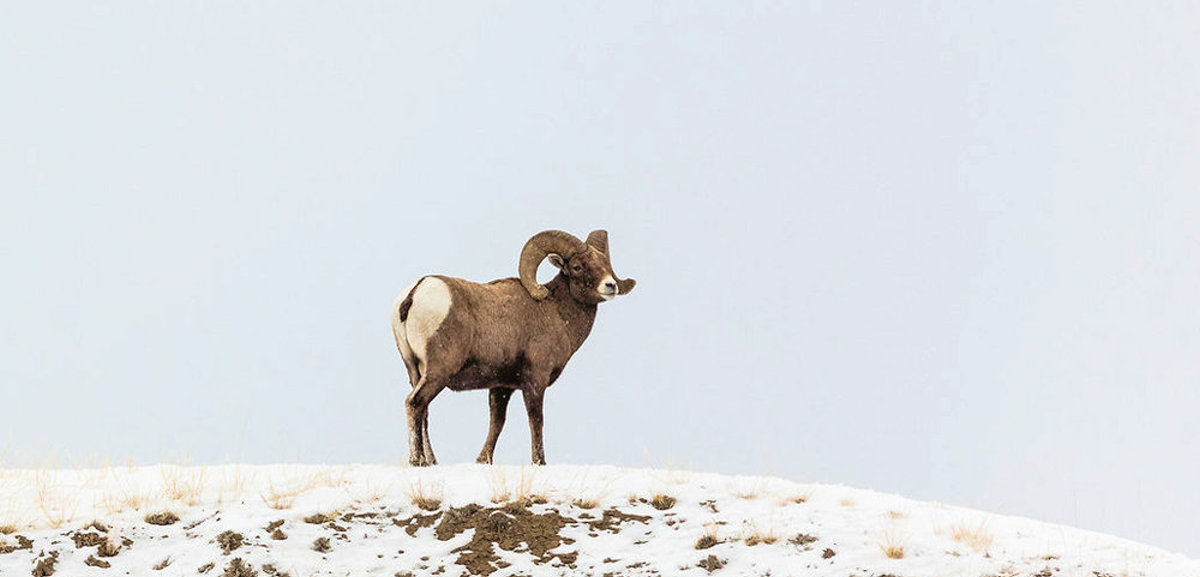
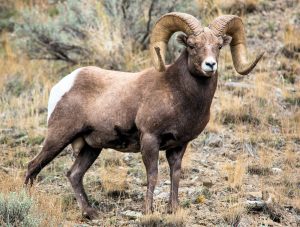
While bison and bears get most of the headlines, the Bighorn Sheep (Ovis canadensis) is the undisputed master of Yellowstone’s vertical world. These agile climbers are a favorite for photographers because they frequent the park’s dramatic cliffs and rocky canyons.
Where to Find Them
Bighorn sheep are most commonly seen in the Northern Range of the park. Unlike the bison that wander the flat valleys, you’ll need to look up to find these residents.
- Gardiner, Montana: Often seen on the cliffs near the North Entrance and the Roosevelt Arch.
- Mount Everts: The steep, layered cliffs between Mammoth Hot Springs and Gardiner are a primary habitat.
- Tower-Roosevelt: Look toward the basalt columns and ridges near the Calcite Springs overlook.
- Dunraven Pass: High-elevation summer range for some bachelor rams.
Survival of the Fittest: Key Traits
Bighorns are built for a high-stakes environment where one wrong step could be fatal.
| Feature | Adaptation |
| Hooves | Hard on the outside with a soft, rubbery center that acts like a suction cup on slick rock. |
| Horns | Unlike antlers, these are never shed. An adult ram’s horns can weigh up to 30 lbs ($14$ kg)—more than all the bones in its body combined. |
| Vision | Their eyes are set on the sides of their head, providing a wide field of view to spot predators from below. |
| Digestive System | A four-chambered stomach allows them to extract nutrients from dry, high-altitude grasses and woody shrubs. |
Behavior: The “Head-Butt”
The most famous bighorn behavior is the rut (mating season), which typically occurs in November and December.
- The Clash: To establish dominance, rams will square off, rise on their hind legs, and charge at speeds up to 40 mph.
- The Sound: The “crack” of their horns colliding is incredibly loud and can often be heard from a mile away.
- Safety First: Their skulls are double-layered and reinforced with struts of bone to act as a shock absorber, protecting their brains from the massive force of the impact.
Fun Fact: You can tell a bighorn’s age by counting the “annuli” (growth rings) on their horns, much like counting the rings on a tree.
Conservation Note
Yellowstone’s bighorn sheep are susceptible to pneumonia, often contracted from domestic sheep outside park boundaries. The park service monitors these populations closely to ensure these “rock stars” continue to thrive on the cliffs.